Friday, January 22, 2010

Basic Landscaping Design II – Style

Spring will come, fortunately much sooner than we think. Let’s be prepared by adding some style to the basic landscape plan we developed last week.

Where do I put features in my yard? That depends on style. Style is formal or informal. Formal tends to be symmetrical and balanced. Formal is usually more square and cornered than curved. In our illustration, symmetrical balance shows the same plants on either side of the door and house. The plantings are the same size. Things match. Informal is balanced in terms of visual weight and mass but not equal matches. Informal landscaping has curved beds, softer lines and balance obtained by visual weight without exact symmetry.

Style should complement and coordinate with the house and yard. A Victorian house tends to invite a more formal style. So does a traditional colonial. A log home, a country French, Tudor, ranch, cottage or any country style house invites informal, asymmetrical style. Informal is considerably more common than formal. The White House is formal. Our beautiful Kentucky log homes are informal. Most homes fall somewhere between. Symmetry has its place in country style landscaping but the materials or plantings might have a more casual air.

An informal home may have symmetry in its architecture. Informal landscaping will add interest to the symmetry. Formal landscaping will continue the symmetrical trend but might either crowd the house or be too repetitive. Asymmetrical home-style works well with informal landscaping. There are outsets and insets that are natural places for foundation beds.

Tall homes like tall trees. Low slung ranch style is flattered by rounded landscaping that blends with long, low rooflines. Tall landscaping on the edges of the lot give the feeling of spaciousness and make a home appear larger. Avoid crowding large plantings near the front door, start with lower plantings and gain height as you move the design to the outer reaches of the yard.

Artful landscaping creates visual interest. A curved sidewalk or a straight walk with an extra angle is much more interesting than a straight shot. Everything in your yard is an invitation; to your door, to your back yard, to a secluded area in your back yard. Create a sense of place and destination whenever you can. An outdoor table and chairs or a bench create a place. Things that suggest a leisurely walk like a path or stepping-stones create destination.

The front door is the focal point of any house. If there is a porch, use this fortunate feature to add additional welcoming items. Place inviting chairs, flowerpots, evergreens in pots and plantings in beds around the porch. Change some of your front door landscaping with the seasons. Each day a front door will welcome and invite you cheerfully into your home. Your guests will feel it too.

Consider your chosen style when finishing your landscape plan. Take a photo of your house and make copies of the photo. Sketch some variations on the copies. Add this style to the landscape overview we did last week. This will give your landscape plan personality. Next week we will discuss plantings to fill out your landscape plan that fit with your chosen style.

Friday, January 15, 2010

Basic Landscape Design I

Getting cabin fever? Use long winter days to plan your garden. We will draw sketches and plans of your yard so that you can greet spring with a plan for home improvement. This keeps you on track over time, helping you to focus on goals.

On blank paper sketch your yard boundaries. You can go outside and measure (brrr!) or pull out your appraisal from your mortgage. The latter will give your lot boundaries and home exterior dimensions. A land survey will provide the same information. Sometimes your deed will provide these measurements. Or you can estimate. Our goal is a rough sketch.

Draw the outline of your house, patio or deck, outbuildings, major trees, flowerbeds, shrubs and your vegetable garden if you have one. Sketch in the driveway and sidewalks. Notice the
view from all directions, especially from your windows. Make note of appealing views and things you would rather not see. Note your doors, windows, outdoor condensers, and trash areas. Are there areas that you would like more screening for privacy? Where are the electric and gas lines and buried cables and sewer lines? Mark North so you can track the sun, shade and wind patterns. You now have a preliminary site analysis.

Next you can make a landscape plan. Select graph paper to layout a scale drawing of your site and the present elements of your home and garden. Select a scale of ¼ inch equals 5 feet. You can use any scale, but this will fit well on a sheet of paper for the average yard. Transfer all the elements of your sketch to the graph paper. Then make some copies of your site plan, either on a copier or using tracing paper. Be sure to preserve the original scaled landscape plan. Use the copies to sketch ideas and create your final plan.

Consider what you would like. What do you want to add, modify or remove? Maybe it is not financially feasible this year, but if you include it your plan now, the area will be available and not covered by a storage shed or tomato patch. Do you need more trees, a storage shed, a potting shed, a secluded garden, a privacy hedge or foundation plantings? How about window boxes, a stone path, a wildflower area, wind break, drainage improvement, water feature, fire pit, gazebo, dog kennel, or a clothesline? Maybe there is an area that is all weeds or a spot where nothing will grow. Include your hopes in your plans. Over time you can make separate projects of them and make them happen.

After you sketch your wish list into your plan your landscape drawing becomes your roadmap. Use it to mold your yard into your own creation. It can be simple, ornate, relaxed, whatever style you wish. Good planning and landscaping add enjoyment to your home and value to your property. In our next column we will discuss how to work in your ideas to coordinate with your house and present landscaping.

Tuesday, January 5, 2010

Forcing Paper Whites

January is traditionally the time to clear out the holiday decorations. But things then seem so bare! But forcing paperwhite narcissus gives a lovely floral display that is something special to anticipate. No special gardening skills are required.

Paperwhites, (narcissus tazetta), are the most simple spring bulb to force. Forcing bulbs indoors makes them bloom earlier than normal. Within four weeks you can have a fragrant spring display. Start now and you can have this display by February or earlier. Wow! Think how welcome fresh flowers will be in the depth of winter!

Begin with a shallow dish, three to four inches deep. For an eight to ten inch dish use at least six bulbs. Lay gravel, pebbles or marbles on the bottom of the dish. Place the bulbs on the gravel pointed end up. Crowd them in. The flat base of each bulb should be level with the other bulbs. Surround them with the gravel to stabilize the bulbs. Add enough water to touch the bottom of the bulbs and no more. Place in a moderately lit, cool area of your home. Continue to water, keeping the water at the same level. When the roots are growing and the bulb shoots are one to two inches tall, place in a sunny location, usually in front of a window. Avoid very warm locations as this will cause the stems to get floppy.

After the first week, pour off the water. Replace with a solution of 1 part rubbing alcohol, (isopropyl alcohol) 10 parts water. Bring the water/alcohol solution again to the bottom of the bulb. Extension Service research shows that the alcohol solution keeps the plant from getting too tall and leggy. Continue to water with the alcohol/water solution, keeping the water level at the bottom of the bulb. After the blooms appear, move to indirect lighting rather than full sun.

Although paperwhite bulbs can be planted in soil to force, the risk of root rot is considerably higher. The method above assures you of the most success.

You can start batches of paperwhites every two weeks for a continuous display throughout February, March and April. Bulbs can be found at most home and garden stores. Cultivars available in Kentucky stores should force very well. After the blooms have died, the bulbs can be planted in the ground. However the success rate is not good as the bulb has been spent in forcing. The forced bulbs may not bloom for a year or two, if at all. You may simply want to place the bulbs on the compost pile.

Enjoy your blooming paperwhites on a sunny window sill or table. Give them as a gift. The joy of flowers before the arrival of spring is appreciated by all.

Friday, December 18, 2009

Use Poinsettias for a Vivid Christmas Display

Poinsettias are vibrant plants to display at Christmas. As a centerpiece on a dinner table, in a basket on the floor, or in a grouping on a coffee table they make a dramatic display. They can be lovely grouped in an unused fireplace or sitting on a table or chair in a foyer. For the price, they pack a lot of color and decorating impact. Paired with pinecones and ever-greenery, poinsettias make not only a holiday display but also look festive all winter. Striking as always in deep red, poinsettias are now available in pink, creamy white and or coated with glitter or powder to look like snow. Sometimes they are even mixed in with other houseplants, all in one container. When potted as a single plant they usually are sold with a plastic foil wrap around the pot. When bringing it home from a store, keep the plant itself covered to protect it from cold. Poinsettias are semi-tropical plants and don’t like temperatures below 55 degrees. Below that temperature they will drop their leaves.

With proper care a poinsettia will keep its colorful bracts, the red leaves that give it color, for months. When purchasing, look for healthy plants, avoiding plants with curled leaves or browned leaf tips. Water the plant when the first two inches of soil is dry. Don’t let the pot sit in water, especially in plastic foil. Un-drained, it will quickly develop root rot. But if it dries enough to curl the leaves, quite a few leaves and bracts will drop off. Fertilize with houseplant fertilizer after the first month, fertilizing every two weeks thereafter. Keep in a very sunny location for at least six hours a day. Low light will also cause leaf drop. Keep from cold drafts or touching cold windows.

Poinsettias are not poisonous to people or pets, although this is a popularly held notion. Careful testing by Extension Services has demonstrated that eating poinsettia might upset the stomach but it is not poisonous.

Who has not seen a pitiful, leggy poinsettia in early February, with most of its leaves dropped? The plant has either been under or over-watered or not given enough light. It can be trimmed back and resurrected by the care described above. Poinsettias grow year round in Florida and further south and will grow outside in pots in Kentucky over the summer. They will get three to four feet tall if repotted and will continue to bloom. Bring them indoors in September. Continue fertilizing and watering the plant and it will reward you with its vivid colors for as long as you wish to keep it.

Thursday, December 10, 2009

Gifts from the Garden

Gifts from and for gardeners are novel and appreciated. Don’t overlook garden gifts just because gardening is a warm weather pastime. Gardeners are usually longing for warm weather, thinking about next summer’s flowers and fretting about weeds in their flowerbeds that won’t freeze.

Gifts from the garden are unexpected and give a long time. Give a hanging pot with petunia seeds. Take an 8 or 10-inch diameter hanging pot. Fill it with potting soil. Potting soil is still available in home and garden stores. Sprinkle with petunia seeds. Cover seeds with ¼ inch of soil. Wave© petunia seeds are readily available and the most prolific petunia. Water the pot by sprinkling very gently. No need to soak it. Cover with kitchen plastic wrap. Tie a bow around the rim of the pot, securing the plastic wrap and decorating the pot. The plastic stays on until the seeds sprout. Instruct the gift recipient to place in a sunny window. Include the seed packet with the gift. These will be ready to place outdoors in April and bloom on schedule for spring. Flower enthusiasts will love it.

Christmas themed gifts of greenery are treasured all winter long. Pine and cedar blanket our mountains and trimming inconspicuous boughs for gifts will do little damage. For centerpieces wire a few sticks together, leaving a space in the middle. Tuck greenery into the sticks and secure with wire. Add a red or gold candle to the middle. Wire in some small, colorful Christmas ornaments and a bow. You have a centerpiece that makes a lovely hostess gift. Care must always be taken to avoid fires.

Pine swags decorated with pinecones and red plaid ribbon are versatile. Everyone has a mailbox and most mailboxes could use a pine swag. Bunch the greenery with wire and trim with ribbon. Outdoor greenery gifts will last all winter and be remembered kindly, long after Christmas.

Seed packets themselves make wonderful gifts. The miracle of seeds makes everyone want to garden. People like to start seeds indoors in February, so gifts of seeds get the gardener dreaming early. Seed starter kits are also available. A few seed packets tied with raffia make a nice gift or the packets can be tied to a gift package. Attractive flower seed packets can even be matted and framed and have a special beauty to the gardening enthusiast.

For the gardener, gardening hand tools and gloves are treasured. Most can use an extra hand spade or a hand pruner. Most gardeners like some fertilizer for flowers. Baskets and tool trays are welcomed to keep their tools handy as they move around their yard. Hose nozzles, hose repair kits and hose timers would be a useful surprise. Novelties like decorated stepping-stones, cone shaped vine trellises and flowerpots catch the gardener’s eye. What is popular in spring and summer will bring a smile to your favorite gardener.

Tuesday, December 1, 2009

Bring the Outdoors Inside – Botanicals of Pressed Flowers or Leaves


Remember the leaf scrapbooks we made in grade school? Who would imagine the simple techniques we learned then could create exquisite art? Or you could make something so lovely without having artistic talent. Nature is the consummate artist; we are the preservers of beauty literally showered upon us.

Pressing flowers and leaves starts with picking attractive plants. Roses are still in bloom and some colored leaves remain on trees. Interesting weeds and ferns abound. These press well. Pick the brightest colors and the most interesting leaf shapes. Compound leaves do well also. Pick extras.

Use thick books to press. I have an old set of encyclopedias that are really great. Lay the flowers in the pages and gently open the flower up as much as it will. If petals fall off you can attach them later. Lay the leaves flat on the pages as well. Don’t lay any plants on top of each other. Close the book and lay a few heavy books on top. Several plants per book will work. Leave undisturbed for a couple weeks. Low humidity is best.

If you are in a hurry you can press the plants between wax paper with an iron. Use a low temperature. Press lightly until you are satisfied with the results. Remove the wax paper gently.

Pressed flowers and leaves are sometimes called everlastings, ephemera or botanicals. Your pressed ephemera can be framed, applied to the outside of frames, glued on cards and invitations or decoupaged onto furniture surfaces. The applications are numerous. In pressed plants you have true natural art with beauty all its own. Use your imagination.

Inexpensive frames and mats can be purchased to match your décor. Depending on your frame size, scrapbook papers make attractive paper to affix your plants. Lay out the flowers or leaves and arrange them with the mat in place so that you know how large your actual lay out space is. Arrange the plants delicately as they are very fragile now in their dried state. Use toothpicks and tweezers to move them. Trim off some leaves from flowers that look too busy. Make arrangements of 2 to 3 flowers, like a freshly gathered bouquet. Arrange fall leaves to capture their falling motion or line them up like a scientific study.

When you like the arrangement, place a tiny dot of lightweight glue under each plant and its petals, stems or lobes. Press lightly and allow drying overnight. Place in their mats and frames. Botanicals fascinate because they are real. Botanicals are often hung in a series, either in a row or a series of rows. To buy them in quantity from a store is expensive. If you make them you will save a lot.

These make lovely hostess and Christmas gifts. From a single leaf or flower to a group in a frame, or combined with a photo or poetry, botanicals are a gardeners gift from nature. From you, the gardener, they’re a natural!

Friday, November 20, 2009

Fall Lawn Care

Fertilizers: If you plan to fertilize once a year, make it in the fall. Cool weather grasses like tall fescue and Kentucky bluegrass are the most frequent lawns grown in Kentucky. These grasses grow best in the fall, especially their roots. Fertilizing at this time builds the root base to prepare the grass for the hot summer months. You can still fertilize in December if you missed in the earlier fall.

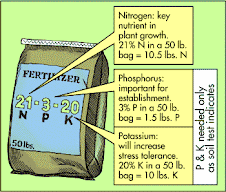
Fertilizers contain three main nutrients, Nitrogen (N), Phosphorus (P), and Potassium (K). Once applied, phosphorus and potassium remain in the soil for several years. Nitrogen washes out. These nutrients are expressed in ratios on fertilizer packaging, to represent N-P-K. A ratio of 10-10-10 in a 30lb. bag of fertilizer means 10 pounds of nitrogen (N), 10 pounds of phosphate (P) and 10 pounds of potash (K). The fertilizer is called ‘balanced’ when the three numbers are equal. When a proper level of P and K is reached in the soil, little additional P or K may be needed for several years.

A new lawn will need a balanced fertilizer. An established lawn will need a fertilizer higher in nitrogen. Regular fertilizing helps prevent weeds. “Weed and Feed’ fertilizers contain herbicides as well. Those containing crabgrass and other grassy weed killers should be applied in mid-April to mid-May. Broadleaf herbicides can be applied in fall and spring.

If you have not had your soil tested before, take two pints of randomly gathered soil to the Extension Office (Rowan County Courthouse or Carter County Courthouse for these two counties). For a few dollars you can get a soil profile that tells you if your soil needs phosphorus (P), potassium (K) or lime. The acidity level of your soil is also analyzed. Based on the Extension recommendation you can apply the needed nutrient to your lawn. You will also add nitrogen. If you are familiar with farming fertilizers, these are cheaper. However they are harder to apply, more apt to burn a lawn and are not formulated to pop right into your spreader. Use these only if you truly know how to use farm fertilizers.

Mowing: Mow often, mow high and keep the blade sharp. Cutting grass too short is the most common damage done to grass. Grass grows more in spring and fall and needs more mowing at those times than in the heat of summer. Kentucky bluegrass should be mowed 2 to 2 ½ inches high. Tall Fescue and Creeping Red Fescue should be mowed 2 to 3 inches high. Mowing shorter than these heights restricts root development, and grasses become easily diseased, or heat and drought damaged, not to mention more easily infested with weeds. Here is a general rule to follow: Mow often enough so that no more than 1/3 to ½ of the grass leafage is removed at any one time. If the grass grows too tall, raise the mowing height, and mow again in a few days. Don’t mow it all at once. You will damage your grass.